
Finding the Best Place to Keep Emergency Fund in Malaysia 2026
Deciding the best place to keep emergency fund Malaysia 2026 is a crucial financial decision for every Malaysian. An emergency fund acts as your personal safety net, protecting you from unexpected financial shocks. It prevents you from dipping into investments or incurring debt when life unexpected challenges arise.
This guide explores suitable options within Malaysia, focusing on liquidity, safety, and potential returns. Choose a strategy that aligns with your personal risk tolerance and financial goals.
What is an Emergency Fund and Why Do Malaysians Need One?
An emergency fund is a stash of readily accessible cash specifically for unforeseen expenses. These might include sudden job loss, medical emergencies, urgent home repairs, or unexpected car breakdowns.
Without an emergency fund, Malaysians often resort to high-interest personal loans, credit card debt, or even withdrawing from their EPF Account 2 (though not always advisable for immediate cash). Having this fund provides peace of mind and financial resilience.
Financial experts typically recommend saving at least three to six months’ worth of essential living expenses. For those with dependents or less stable income, aiming for nine to twelve months might be more prudent.
Key Considerations for Your Emergency Fund
Selecting the best place to keep emergency fund Malaysia 2026 involves balancing three critical factors:
Liquidity: Accessing Your Funds Fast
Liquidity means how quickly and easily you can convert your asset into cash without losing value. An emergency fund must be highly liquid.
You need to access these funds immediately when an emergency strikes, not weeks or months later. Avoid options that lock up your money or impose penalties for early withdrawal.
Safety: Protecting Your Capital
The primary goal of an emergency fund is capital preservation, not growth. You cannot afford to lose money here.
Prioritise options that are secure and regulated, ideally covered by Perbadanan Insurans Deposit Malaysia (PIDM) for deposits up to RM250,000 per depositor per bank.
Yield: Beating Inflation (Slightly)
While safety and liquidity are paramount, aiming for a modest return helps combat inflation. Malaysia’s inflation rate can erode your savings’ purchasing power over time.
Look for options that offer slightly better returns than a standard savings account, without compromising on the first two factors.
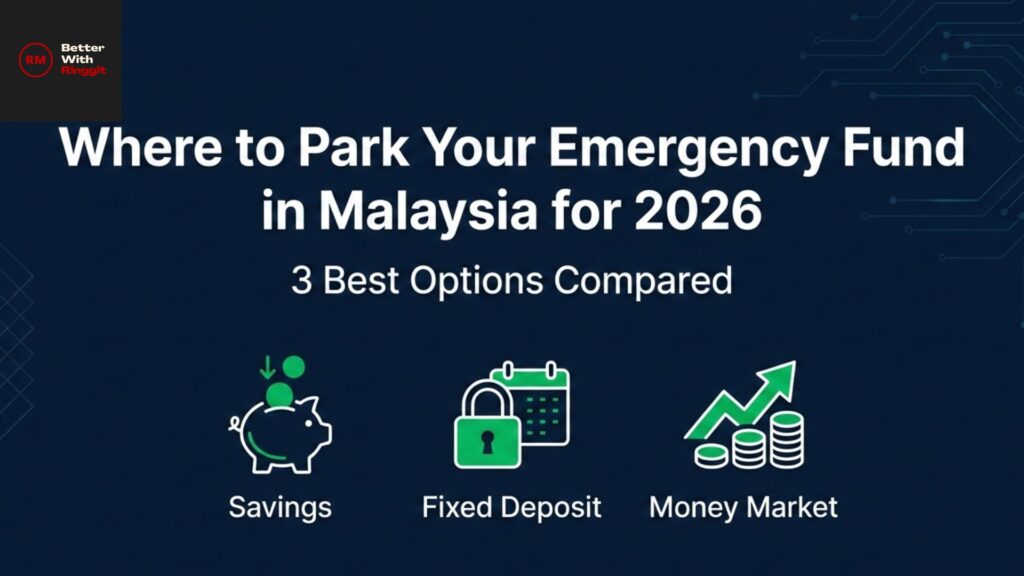
Comparing the Best Place to Keep Emergency Fund Malaysia 2026 Options
Let’s examine the most common and suitable places for your emergency fund in Malaysia.
High-Yield Savings Accounts
These accounts offer higher interest rates than regular savings accounts, often with specific conditions like maintaining a minimum balance, performing a certain number of transactions, or linking to a credit card.
- Pros: High liquidity (funds available instantly), PIDM-insured, relatively good interest rates compared to basic savings.
- Cons: Interest rates can fluctuate, conditions might be complex to meet, often capped interest for certain tiers.
- Examples: OCBC 360 Account (3.0% p.a. with conditions), UOB Stash Savings Account, CIMB Basic Savings Account, and Maybank Savings Account. Compare the latest offerings carefully.
Fixed Deposits (FDs)
Fixed deposits involve locking your money for a specific period (e.g., 1, 3, 6, 12 months) in exchange for a guaranteed interest rate.
- Pros: Guaranteed returns, PIDM-insured, generally higher rates than basic savings.
- Cons: Lower liquidity (penalties for early withdrawal, or loss of accrued interest), not ideal if you need instant access to the *entire* sum.
- Suitability: Consider short-term FDs (1-3 months) for a portion of your emergency fund, especially if you have a larger fund and can stagger maturities.
Explore current FD promotions from various banks.
Money Market Funds (MMFs)
Money Market Funds are unit trust funds that invest in short-term, highly liquid, low-risk debt instruments like government securities, commercial papers, and bank deposits.
- Pros: Higher potential returns than savings accounts (not guaranteed but generally stable), good liquidity (can typically withdraw within T+1 to T+3 business days), diversified low-risk exposure.
- Cons: Not PIDM-insured (though highly regulated by Securities Commission Malaysia), small risk of capital loss (though historically very low), slight delay in accessing funds.
- Examples: Available through various unit trust platforms or robo-advisors like StashAway Simple, Wahed Invest, or through conventional fund houses.
Consider an MMF for the larger, less immediate portion of your emergency fund.
Comparison Table: Emergency Fund Options
| Option | Liquidity | Safety (PIDM) | Typical Yield (Approx.) | Suitability for Emergency Fund |
|---|---|---|---|---|
| High-Yield Savings Account | Excellent (Instant) | Yes | 1.5% – 2.5% p.a. | Excellent for immediate, smaller emergencies. |
| Fixed Deposits (Short-term) | Good (With penalty) | Yes | 2.5% – 3.5% p.a. | Good for a portion of the fund, laddering strategy. |
| Money Market Fund | Good (T+1 to T+3 days) | No (SC regulated) | 3.0% – 4.0% p.a. | Good for larger, less immediate portion, higher returns. |
Other Less Suitable Options
While tempting, certain popular Malaysian instruments are less ideal for a primary emergency fund due to liquidity constraints or risk:
- ASB/ASN (Amanah Saham Bumiputera/Nasional): Excellent returns for Bumiputera. However, processing withdrawals can take a few business days, making it less instant than a savings account. Good for a secondary, less immediate portion.
- Unit Trusts (Equity-based): Too volatile. The value can drop significantly right when you need the money. Avoid for emergency funds.
- Shares/ETFs: High volatility and market risk. Not suitable.
Practical Tips for Managing Your Emergency Fund
- Separate Account: Keep your emergency fund in a separate account from your daily spending. This avoids accidental spending and helps you clearly track its growth.
- Automate Savings: Set up a standing instruction from your salary account to automatically transfer a fixed amount to your emergency fund each month. Consistency builds wealth.
- Start Small: If 3-6 months’ expenses seem daunting, aim for RM1,000 first, then build up to one month, and so on. Every bit helps.
- Replenish When Used: If you dip into your fund, make replenishing it your top financial priority.
- Review Annually: Re-evaluate your fund’s size and where it’s kept at least once a year. Your living expenses or financial situation might have changed.
Conclusion
Securing the best place to keep emergency fund Malaysia 2026 requires careful thought. Prioritise options that offer excellent liquidity and high safety, even if it means slightly lower returns.
For most Malaysians, a combination of a high-yield savings account for immediate access and a money market fund or short-term fixed deposit for the larger portion offers a balanced approach. Start building your fund today to safeguard your financial future against life’s unpredictable moments.
Disclaimer: All rates stated are current as of January 2026. Bank interest rates and promotional rates change frequently. Please verify current rates with your chosen financial institution before making a decision. Past performance of MMFs does not guarantee future returns.